We had an amazing Open Form showing at our 13th Annual Tournament this year. The Junior Competitors stepped it up this year, demonstrating their dedication to their Martial Arts training. The Adult division was stacked with the most exciting and dynamic competition to date!
Everyone did such an exceptional job with their choreography and music choice, I’m sure they have inspired some other members of our organization to participate next year. Here is a guide specifically for those who may be interested in using weapons in their Open Forms.
Step 1: Choose Your Weapon!
Choose a weapon that “speaks” to you. Choose a weapon that you are comfortable wielding. A weapon should be an extension of your own body. It should be a part of you. If you are uncomfortable with a certain type of weapon, your technique will suffer.
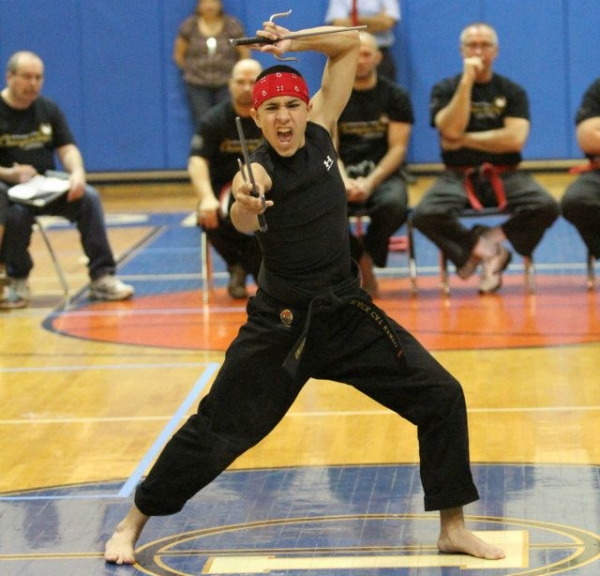
I recommend using weapons that translate well with your training in US Black Cat Kenpo. Smaller, duel weapons are an easier transition from your traditional forms. I would recommend starting with Nunchucks, Sais, or Kamas. You can insert any one of these into our 9 USBCK forms with little variation. Larger weapons such as bo staff or katana swords require much more practice to become proficient. A bigger weapon makes any flaw in your technique more evident to the judges…
Step 2: Back to Basics
Weapon Forms are still Katas. What are the elements of good kata?
- Attitude
- Focus in technique
- Power in blocks and strikes
- Strong traditional stances
- Snapping your head before turning
- Exhales and Kias!
- A pattern that tells a story (Beginning, middle, and end)
- If using music, choreography should match the song
Your weapon form MUST have all of theses. If you forget to include any one of the above bullet points, you cannot maximize your kata score. Remember, the weapon form has to have elements of traditional USBCK kata, not baton twirling.
Step 3: Controlling your Weapon
This is the step where you are now perfecting the techniques that you have choreographed. Controlling your weapon during your form is where you can gain, or lose much of your total kata score.
- Safety. The Number One Priority. Is your weapon secure? Are there any cracks or points of wear and tear? When going full force, an unsafe weapon can be dangerous to yourself, judges, and/or spectators.
- If using duel weapons, they should not hit or “clank” against each other. A crossing technique such as a Cross-Arm Upper is ok, but while striking or twirling, the weapons should not hit each other.
- The weapon should not hit your body. Some weapons such as nunchucks and bo staff have techniques that require you to “bounce” the weapon off of your body for speed, change of direction, or added stability to a strike. That’s fine. While moving the weapon around it should not inadvertently hit any body part, especially the head.
- Weapon should not hit the floor. Some Chinese Martial Arts have techniques where the weapon is slammed on the floor as a strike. Although correct, most weapons should not hit the floor, especially bladed weapons. If you are telling a martial arts story about defending yourself, you just broke or dulled your weapon.
- Weapons should not get caught in uniform. Wear appropriate attire to minimize the likelihood of tying up your weapon.
- If doing any releasing moves, make sure you catch securely, with a solid grip, and with control of the weapon. Any high difficulty maneuvers will increase your kata score. However, they also come with high-risk factor of dropping your weapon. NEVER drop the weapon.
- In competition or demonstration, always keep your form and techniques at a safe distance from the spectators. A sword swinging six inches away from the judges is a big deduction, not to mention very dangerous.
Now is the time to start practicing! Perfecting a weapons form takes months of practice and PATIENCE. Use endless videos available online, read books, watch your favorite martial arts movies, or ask your instructor for some ideas. Use these steps to improve your weapons proficiency and maximize your kata score. Good Luck! I’ll see you next weapons seminar.